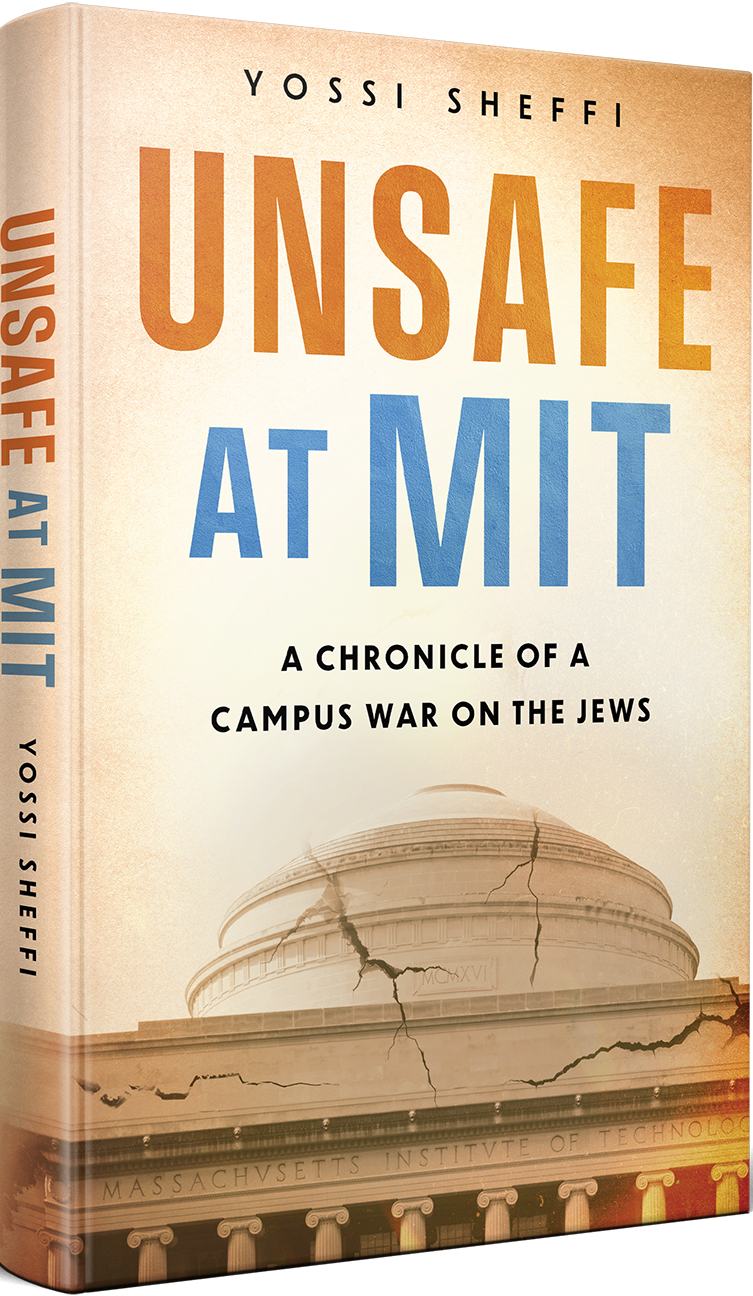
Unsafe at MIT

A Chronicle of a Campus War on the Jews
Body

For Jewish and Israeli students at MIT, the days and months following October 7 profoundly changed campus life. Campus corridors, which once reverberated with the voices of researchers discussing problems and sharing solutions, became an echo chamber of hostility and intimidation. For many students, the experience reshaped not only their education but also their sense of belonging at one of the world's leading universities.

Based on dozens of interviews and drawing on administration correspondence, social media posts, and television footage, this book tells the story of that transformation through the voices of those who lived it. Some of these events made national headlines, while others unfolded quietly in classrooms, residence halls, and student spaces. Together, they reveal how a global conflict reverberated through a campus community.

This oral history chronicles the multiple fronts that Jewish and Israeli students faced, including the fight for the truth, the fight against delegitimization, the fight against the Boycott, Divestment, and Sanctions (BDS) campaign, and the fight against the erosion of law and order on campus. Their stories illuminate a broader institutional failure: the erosion of MIT's commitment to prioritizing innovation above dogma and the consequences that follow when a university abandons the standards that define it. Offering a firsthand account of a pivotal chapter in MIT's history, the book also explores the responsibilities institutions bear when the conditions necessary for learning, inquiry, and intellectual freedom are undermined.

Yossi Sheffi

For more than 50 years, Dr. Yossi Sheffi has been a professor, researcher, and academic leader at MIT. Following October 7, 2023, he was confronted by reports from Jewish and Israeli students at the institution he has called home for decades, and set out to document what was happening on campus.

Drawing on interviews, correspondence, social media posts, and public records, Unsafe at MIT documents the experiences of Jewish and Israeli students and examines how a global conflict reverberated through one of the world's leading universities.

While Dr. Sheffi is the author of nine award-winning books and is widely recognized for his analytical approach to complex issues, this publication marks a departure from his previous work.

"I could not stand back and act as if this unfair treatment of students was not going on. I had to let their voices be heard," said Sheffi.

Considered one of the world's leading experts in supply chain management, Dr. Sheffi has authored nine award-winning books, founded or co-founded six successful companies, advised organizations across the private and nonprofit sectors, and publishes the Chain Reaction newsletter, which reaches nearly 70,000 subscribers each month. He has been recognized repeatedly by both academic and industry organizations throughout a career spanning more than five decades.

Endorsements

“This book serves as a historical record in the unfolding chapters of contemporary Jewish history. The explosion of antisemitism that swept across MIT in the aftermath of October 7th is a microcosm of the anti-Jewish animus that flooded campuses, media institutions, and city streets following the deadliest massacre of Jews since the Holocaust. This work sheds light on the failure of institutional leadership to protect their Jewish communities, while students, faculty, and community leaders had no choice but to step forward and meet the moment with courage and resilience. Their story is chronicled in these pages and should serve as a lasting lesson for the next generation of Jewish leaders.”

— Dr. Yechiel Leiter, Israeli ambassador to the United States


 “Deeply personal, rigorously documented, and at times enraging—Sheffi’s account of Jewish and Israeli life at MIT after October 7 is both a witness testimony and a case study in institutional failure. That he also points toward constructive responses makes it more than a lament.”

— Jason Furman, Aetna Professor of the Practice of Economic Policy, Harvard University and Former Chair of the Council of Economic Advisers in the Obama Administration


“It is essential for insiders to document the academic antisemitism they have experienced or observed. Professor Sheffi’s book is a tour-de-force through the experiences of dozens of MIT students and staff.”

— Alan Dershowitz, Felix Frankfurter Professor of Law, Emeritus, Harvard Law School


“In the service of any future study of jihad in America, Professor Sheffi has compiled an invaluable record of the thuggish assault on MIT, one of the twin academic towers of Cambridge, MA. As demonstrated in the book, the attacks after October 7, 2023, destroyed the elements of a ‘respectful, welcoming, and productive community’ necessary for scientific inquiry. If they survive intact, the school and the country will be greatly in his debt.”

— Ruth Wisse, Emerita, Harvard University and Senior Fellow of Tikvah


Contact

Media Interviews:

Contact: Yehudit Singer-Freud

Email: yehudit@singerpublicity.com

Telephone: +972 546 170 773


Speakers Bureau:

Mollie Plotkin Group, LLC

Contact: Mollie Plotkin Pogachefsky, President

Telephone:  (215) 510-6607

E-mail: Mollie@mollieplotkingroup.com

Web:  https://mollieplotkingroup.com/

Book Reviews

The logo of The Wall Street Journal

The Intifada at MIT, The Wall Street Journal, July 2026

The logo of The Wall Street Journal

Equality, Except for the Jews, The Wall Street Journal, July 2026

The logo of AISH

Unsafe at MIT, AISH, July 2026

x.com logo

Unsafe at MIT Review, Prof. Retsef Levi, MIT Sloan School of Management, July 2026

Instagram logo

A book with a lot of chutzpah, Jennifer Lentz, July 2026

Body


Excerpt, Chapter 1: Awakening

October 7, 2023

It was still dark when Yuval woke up in the Cambridge apartment he shared with his wife and their six-year-old son. He had slept poorly since going to bed amid reports of sirens in Israel. Not that these “code red” alerts were all that unusual. Back home, these tzeva adom warnings were pretty much part of the background noise, alerting communities in Israel to incoming missiles launched by any of the terrorist groups operating in the Gaza Strip. But at 4 a.m., his phone lit up with notifications, and as he pulled the screen closer, he struggled to make sense of what he was seeing. He read reports of Hamas infiltrations of kibbutzim in the South, stared at videos of trucks bristling with gunmen driving unopposed through the streets of Sderot, and scrolled through a torrent of anxious chatter on WhatsApp.

Worst of all were the messages that were not coming in. Yuval had relatives near the Gaza border, and as the family group chat filled with concerned questions, the responding silence was deafening. Then, after an agonizing delay, a first sign of life: Hamas terrorists are in the kibbutz. We don’t know what’s going on. The IDF is not coming. Later in the day, Yuval learned that his second cousin Assaf had been murdered.

Yuval was an Israeli marine biologist who had arrived at MIT just two months earlier to pursue a postdoctoral position in the Department of Earth, Atmospheric, and Planetary Sciences. When he arrived, it had felt like a dream come true, validation of a scientific career that had grown out of unlikely beginnings. He had grown up in a village surrounded by olive groves and was, by his own account, a bit of a troublemaker who dropped out of school in tenth grade. He completed his army service in the Golani Brigade as an infantryman, part of the last contingent of Israeli soldiers in Gaza before Ariel Sharon ordered the unilateral withdrawal from settlements in that territory in 2005. He embarked on a bachelor’s degree in marine sciences at the Ruppin Academic Center, subsequently completed a master’s degree at Tel Aviv University, and finally earned a PhD in environmental engineering at the Technion. He was happiest near water. His profile photo on LinkedIn showed him bobbing in the Mediterranean wearing a wetsuit and a wide grin. That Saturday, he thought of the friend from his undergraduate program who had taught him to sail. The friend lived in Kfar Aza, the kibbutz where the first paragliders had landed carrying terrorists—and he was not responding to texts.

Later that morning, stunned and disoriented, Yuval went to his lab. He had an experiment running that required his attention. The campus was quiet during the long weekend leading up to Columbus Day, the few people he saw seemingly unperturbed as they went about their routines. Snippets of an old Skeeter Davis song floated into his head. Why does the sun keep on shining? Why does the sea rush to shore? Don’t they know it’s the end of the world?

In the afternoon, he dragged his family through the Harvard Museum of Natural History. His brother was visiting, and although none of the adults were in the mood for sightseeing, Yuval and his wife needed something to distract their son. Later, Yuval would be unable to recall a single exhibit.

On social media, nightmarish scenes continued to unfold against the backdrop of familiar locations. Among the first clips to ricochet through Israeli Telegram channels was dash-cam video from the Nova Music Festival: rows of cars parked in a field, trance music still pulsing in the background, when the camera jerks skyward to catch dozens of rocket trails arcing overhead. The driver swears, slams the door, and the frame dissolves into frantic foot traffic as revelers sprint for the tree line. Minutes later, a separate phone recording shows the same grove littered with backpacks while gunfire crackles closer and closer. Another widely shared file stitched together CCTV feeds from Kibbutz Be’eri: men in fatigues and civilian hoodies fanning out of a white pickup, kicking in doors, and tossing grenades into safe rooms. A timestamped porch camera from Kfar Aza captured two militants dragging a bleeding woman by her hair; the clip freezes on her bare feet, leaving a smear across the tiled patio. Farther south, helmet-cam footage showed a squad firing point-blank into the bedroom of a nursery school, the walls already pocked with shrapnel. By mid-morning, Israeli news channels were looping aerial shots of the festival grounds: scorched cars fused to the asphalt on Route 232, bodies still strapped into driver’s seats.

As the day went on, people across southern Israel continued to huddle in safe rooms. Those who still had working cell phones made whispered calls to relatives and news networks to report the shots that were still ricocheting in the streets, the fires that were making it hard to breathe, the desperate calculations about whether to risk smoke asphyxiation or break out and face certain capture. Festivalgoers were still cowering in fields, weak with fear and dehydration.

In Kfar Aza, Palestinian infiltrators would battle for days with residents and the overwhelmed contingent of soldiers that finally showed up. It would be Tuesday before the last terrorist who had barricaded himself inside one of the homes was killed. By then, it was confirmed that Yuval’s friend from the marine science center had been shot dead.

But what increasingly haunted Yuval was not just the news from home—it was also the silence of his fellow researchers who didn’t think to check in on him. And it was the absence of any statement by the university administration, whether in condemnation of the attacks or just in support of those members of MIT who were suffering.

That suffering took many forms during those first confused days. Over the following months, the Israeli and Jewish students, postdocs, and faculty would come to be viewed as a faction at MIT, a beleaguered group that sent petitions and delegations to the administration, convened over weekly lunches, and, in a few instances, staged their own actions. But on that Saturday, they experienced the news of the massacre—the worst mass-killing of Jews since the Holocaust—as individuals. Even the few Diaspora Jews who had never been to the country knew someone in Israel, whether from summer camp or through family ties. The Israelis had all served in the army and were now tracking the summons calling their friends up for reserve duty. Virtually everyone knew someone who was murdered, abducted, or had fallen in action.

Eitan and Zev, twins on the MIT varsity baseball team, lost friends that day. Someone who had lived on their street and attended the same school; another schoolmate, from the year above them, with whom Eitan had played football; the brother of one of Zev’s closest friends. And they knew Hersh Goldberg-Polin, who had fled the Nova Festival only to have part of his arm blown off by a grenade lobbed into a bomb shelter and then taken as a hostage to Gaza.

The news hit people at different times, too. October 7, 2023, was not only a Sabbath. It was Shmini Atzeret, the eighth and final day of the Sukkot festival that leads into Simchat Torah, the conclusion of the yearly cycle of scriptural reading. For observant Jews who, on holidays, refrain from all electronic devices, this meant the only news they received was by word of mouth. In addition, communities in the Diaspora observe an extra yom-tov, so that while religious Israelis, like Eitan and Zev, faced the avalanche of sickening footage on Saturday evening, observant American Jews stayed off their phones until sundown on Sunday.

Until then, fear filtered into the day’s prayers. Marilyn Meyers, a senior in materials science and engineering, was in a synagogue in New York with friends from Columbia University when the rabbi announced that there had been an attack. He explained that the non-Jewish caretaker had turned on the news upstairs so that those who wanted could stay informed. Synagogues across Israel had done something similar at the outbreak of the Yom Kippur War. Marilyn was born and raised in New York, but she had spent a gap year at a seminary in Israel and had peers who were in the Israel Defense Forces (IDF). She stayed off her phone, determined not to break the Sabbath, however much she wanted to check in with her friends. “It was definitely a heavy chag,” she said.

Akiva, a Ph.D. student in chemical engineering from Somerville, Mass., remembered the exact moment in synagogue when he heard the first vague reports. It was during yizkor, the service honoring the souls of departed loved ones. “If your parents are still alive,” Akiva said, “you don’t stay for that part, you go out into the hallway and chat quietly for ten minutes.” Now, instead of murmured small talk, people traded overheard death counts.

This is an excerpt of Chapter 1, entitled "Awakening," of Unsafe at MIT: A Chronicle of a Campus War on the Jews

International Editions